They say all PR is good PR, and those of us working within the beleaguered Adult Social Care sector know we need to keep our story in the headlines, to carry on knocking on two very important doors in Downing Street that seem to have forgotten that the sector exists, or at very least that it is in financial difficulty.
But at the same time, we need more care home beds to meet the demand created by our ageing population, which means the sector is crying out for external investment.
So we need to ensure that the messages that are being spread by the media are accurate, and, just this week, this seems not to be the case.
For example
On Monday 5th December, Laura Donnelly, health editor at the Daily Telegraph wrote:
“Care home fees soar by one quarter as quality plummets”
“Care home fees have soared by almost a quarter in just one year while the quality of services has slumped, new figures show.”
She states that this was based on a sample of 100 care homes by TrustedCare.co.uk, (whose care home clients are undoubtedly pleased with them spreading this message)
and goes on to say “On average, fees for care homes rose by 23 per cent in one year, the study found. Meanwhile nursing home prices increased by 34 per cent, with a doubling in fees in some parts of the country.”
On the same day Jasper Jackson of The Guardian wrote.
"Cost of social care has rocketed over last year, analysis shows"
So this is my take on the current situation, starting with "spiralling care home fees".
From a sample of 273 care homes for older people, varying in age, style and accommodation provision; they reported an increase of 10% for nursing care and 15% for “personal” or residential care. To this they added “(but also) reflects changes to the quality of the underlying asset base of our sample study as well as evidence of significant strides in improving the quality of the stock, which has been reflected in better fee performance.”
Very little else will have increased between 10% and 15% over the year based on our current low inflation rates, but inflation for care providers is totally different as they have had to incorporate increased Minimum Living Wages, (which will increase again in April), energy costs, which account for most of no payroll costs, (Market experts have announced that the price of gas climbed 29% over the second quarter in 2016 while wholesale electricity prices rose 25%.), and increased training costs, as care workers are given more mandatory subjects.
So now onto "plummeting" care quality.
I continually monitor, and have reported on, the status of the new CQC ratings of care homes, that are based on any overall rating using the aggregates of 5 key criteria, and were introduced in October 2014.
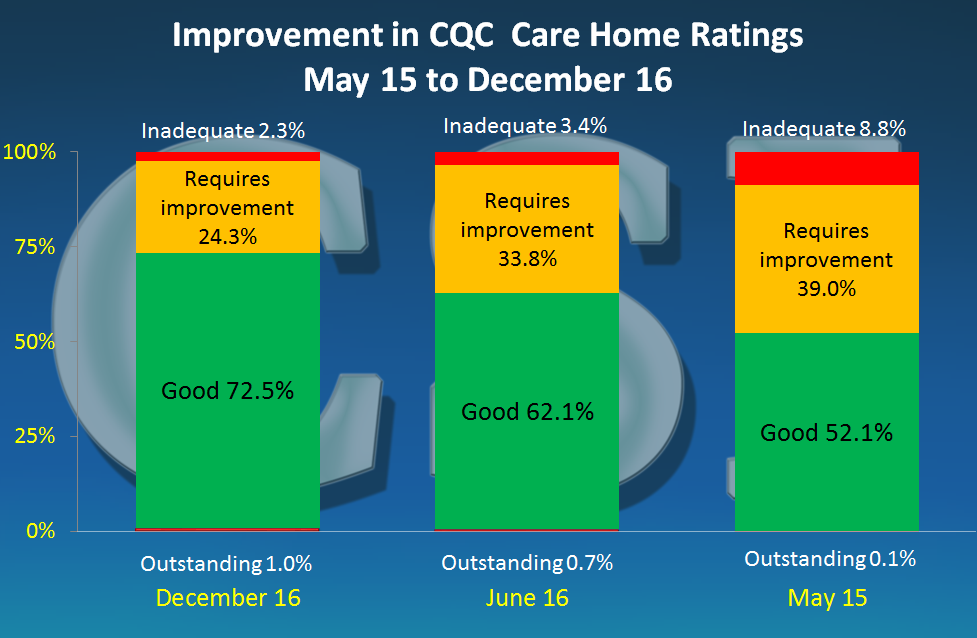
My most recent analysis argues exactly the opposite of care quality trends, and rather than “plummeting” ratings are very much “improving”, despite pressures on the cost of running a care home.
Using data taken directly from the total CQC registers (rather than simply speaking to 100 homes) I can show an increase in the quality of ratings between May 2015, June 2016 and December 2016. (The earlier data has been taken from my insight in July 2016 on this very subject)
Good ratings are up from 52% in May 2015, 62% in June to 72% in December 2016. Likewise Requires improvement has fallen respectively from 39%, 34% and 24%, whilst the worrying Inadequate tag is now displayed upon 2.3% of care homes, around a quarter of those 18 months ago. So well done the CQC, and the care homes that have improved.
Everyone within the sector agrees that this is still work in progress, and we need to ensure that there are no more instances of what has occurred, most recently in Cornwall, and that our elderly people are properly cared for, as they, and one day we, deserve. But we need to put the records straight, and stop telling the World that care quality is “plummeting” and replace it with “improving”.
Another article from the BBC, again on 5th December, headlined “London care home closure rate nearing 'crisis levels'” may well be true as the cost of providing care in the capital will undoubtedly be horrendous, but again there were errors with their figures, albeit they do look back over a 10 year period, rather than focussing on the more recent past.
“Sixty care homes in London have been rated as inadequate by the CQC, because residents were not receiving personal care, and staff were inadequately supervised or insufficiently trained.”
Overstated according to latest CQC data, which says only 25 care home are Inadequate in the London region, of which 16 care for the elderly (maybe they misheard 16 as 60?)
And in fact the number of care homes beds registered by the CQC in the London region has dropped from 30,430 at the start of 2016, by 17 to 30,413.
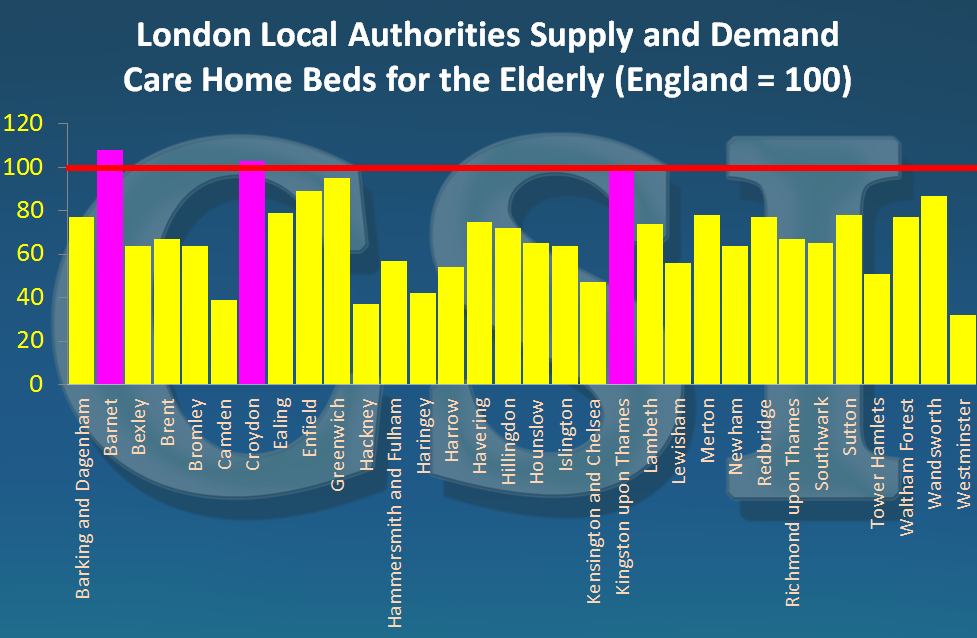
However London does have a major problem with regard to there being enough beds available as I have already reported earlier this year. On average in England there are around 89 beds for every 1,000 over aged 75 or over (that take up 90% of care home beds)
Only 3 out of 32 London boroughs are in line with or above the average, and 15 are less than two thirds the national average. So London authorities already have a problem with available beds, and this will only get worse with a 75 plus population growth of 7% by the next election (when the Government believes it will have to address adult social care)
Social Care is in trouble, much needs to be done by many parties to solve the problem, but I felt I just had to put the record straight, following the inaccurate numbers, and overdramatic headlines in the media.
The data used in the above forecast is taken from CSI's own market intelligence model, called The CHAMP (Care Home Analysis of Market Potential). For more information click here